Resume after power loss
A box is meant to run unattended. Power cuts, kernel panics and restarts will happen while agents are working. When a GurtOS machine comes back, every task that was queued, running or waiting carries on from where it was. No step runs twice, none is skipped, and pending approvals are still pending.
What happens at boot
Section titled “What happens at boot”box.service starts at boot and restarts within a second if it ever exits. When the core starts:
- It reads the log. It drops a half-written last line if there is one, then rebuilds every task and approval by replaying events in order. See the action log.
- It loads the firewall rule and starts the proxy, so task users are network-limited before any of them runs.
- It loads every app and rebuilds each workspace's view from its done layers.
- It resumes tasks. For each task that was
queued,runningorwaiting, it stops any leftover processes of that task's user, remounts the task's copy of the workspace over the same layers it started with, opens its broker and starts its worker again. - It starts serving the API, then app triggers, then reconnects to SpacetimeDB and refills the live tables.
GET /api/health reports when the core started (startedAt) and whether agents are paused. To the box's own machine or a paired device it also reports which tasks it resumed (resumed) and cleanStart, which is false when the last stop was not a clean one. The portal uses them to show a notice after a restart that lists the tasks that picked up where they stopped. If the owner had paused all agents before the cut, resumed tasks stay as they were until the agents are resumed.
A task that was waiting for an OK stays waiting. Its approval is still in your inbox, and you can answer it from the portal or phone as if nothing happened.
The core writes its own state files, such as devices.json, owner.json and permissions.json, beside the final name and then renames them, so a power cut leaves the old file or the new one. If a failing disk leaves one unreadable anyway, the core sets it aside as <name>.torn-<time>, logs a warning, starts without it and writes a security note. It never grants access because a file is unreadable:
- A torn
devices.jsonmeans no phone is paired. Pair your phones again. - A torn
owner.jsonstill counts as an owner being set, so only root or the owner's phone can change the owner. - A torn
permissions.jsonpauses all agents, because the owner's off switches live there. Check Settings, Permissions, then resume them. - A torn
remote.json, which is kept asremote.json.torn, turns remote access off. Turn it on again.
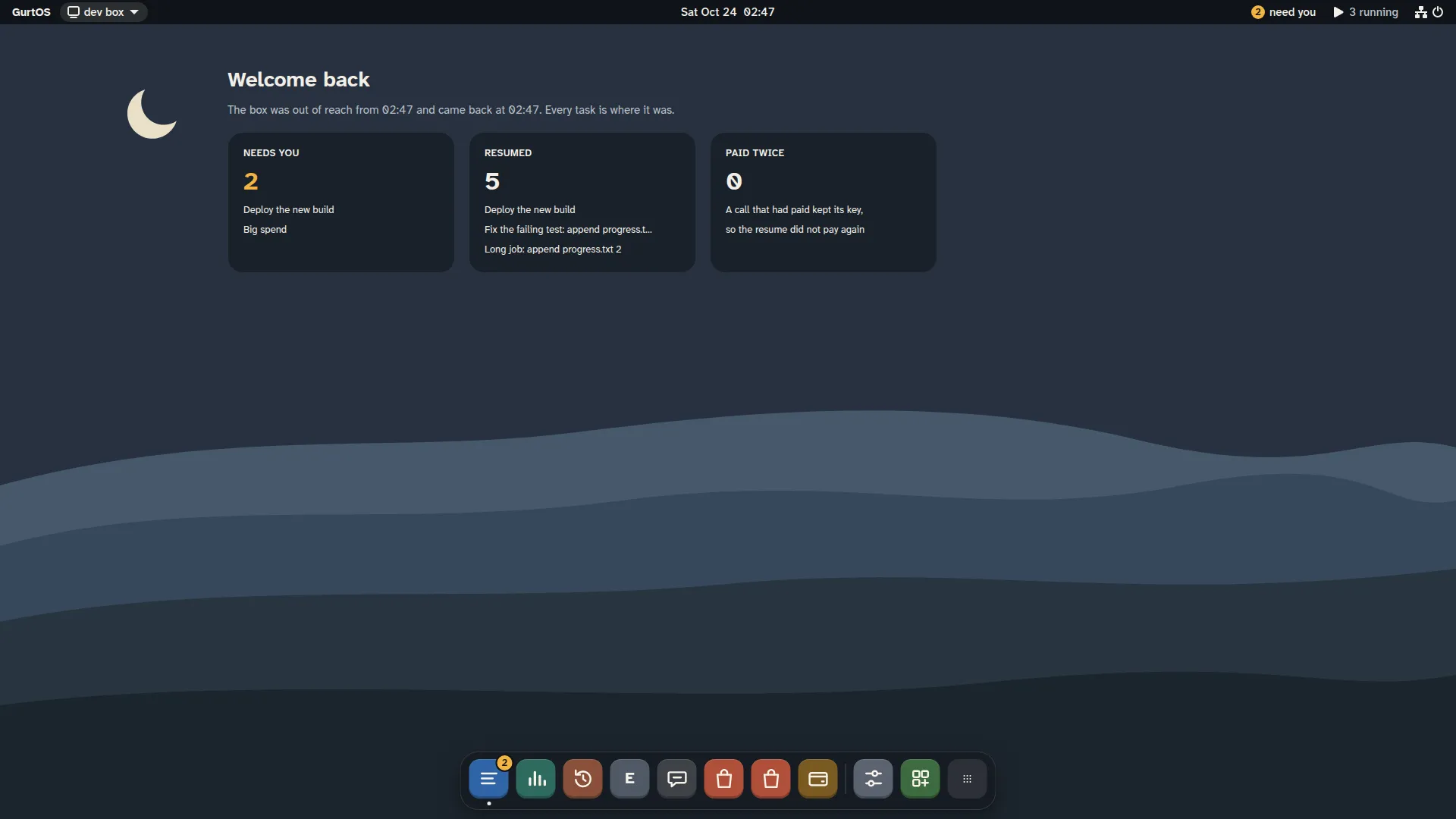
After a power cut, from a test box running scripted tasks.
Why nothing runs twice
Section titled “Why nothing runs twice”Resuming is only safe if work already done is not done again. GurtOS uses three mechanisms.
Files are already there. A task's changes live in its own layer on disk, BOX_HOME/tasks/<id>/upper. Before the core logs a worker's step, it flushes that layer to disk. So when the log says a step is done, its files survived too. The resumed worker sees them in its copy.
Steps tell the worker where it was. The worker asks its broker for GET /task, which returns the task and every step it already logged. A worker uses this to pick up its place:
- Droid saves its session id in its first step. On resume, the worker reopens that session and tells Droid: "The box restarted while you were working on this. Check what is already done in the files, then finish."
- The scripted test worker records a line number with each step and continues from the next line.
Tool calls are keyed. Every tool call carries a key that stays the same across a restart. If the log already has a result for that key, the broker returns it without running the tool. If the call was cut off before its result was logged, it runs again with the same key, and the tool passes that key to its API as an idempotency key. A payment API that saw the first attempt returns the same charge instead of making a second.
Some apps add their own guard. The wallet writes a durable mark before it pays. If the box loses power in the middle of a payment, the resumed call refuses to pay again rather than guess, and you check the payment on the network's explorer.
What the test suite checks
Section titled “What the test suite checks”The test suite acts out a power cut on every run. It starts a long task and a task waiting for an OK, then kills the core and every task process at once, unmounts every overlay, and writes half a line to the end of the log. Then it starts the core again and checks:
- The box came back and picked up the long task.
- The long task finished with every step done exactly once, in order.
- The waiting task was still waiting, with its approval still pending in SpacetimeDB.
- Approving it after the restart let it finish.
- Earlier work survived: a task done before the cut kept its changes, and a task undone before the cut stayed undone.
See the test suite.
On an ISO install
Section titled “On an ISO install”Everything the core needs to resume lives on the data partition: the log, workspaces, task layers, the vault and SpacetimeDB's data. A whole-system update copies the task users into the new system, so a task resumed after an update keeps its uid. See system updates.
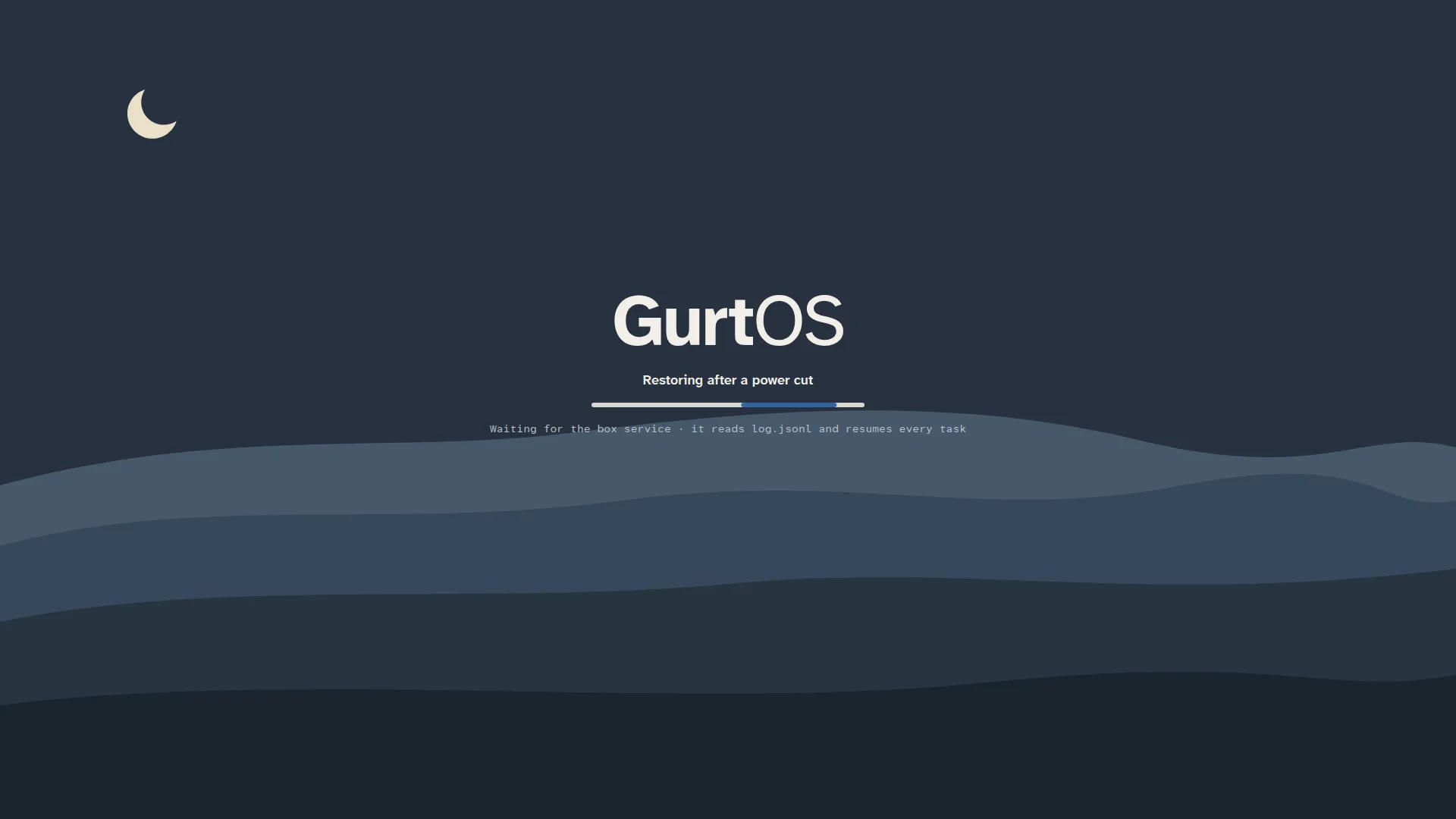
The boot screen while the box restarts, from a test box running scripted tasks.
Limits
Section titled “Limits”- A task resumes, but the model call it was in the middle of does not. Droid redoes its current turn from the files and the session.
- A tool call cut off mid-way runs again. That is safe only for tools that pass
ctx.keyto their API or keep their own durable mark, as the payment tools (wallet.pay,shopper.buy) do. A read-only tool, such as a price check, runs again, which is harmless. - A system that hangs without crashing does not restart by itself. A hardware watchdog would cover that, and is not set up.
- Model cost for a turn cut off by the power cut may not be counted.